in what direction must she walk to head directly home? (round your answer to three decimal places.)
Vectors
In this section you lot will:
- View vectors geometrically.
- Find magnitude and direction.
- Perform vector addition and scalar multiplication.
- Find the component grade of a vector.
- Observe the unit vector in the management of
.
- Perform operations with vectors in terms of
and
.
- Find the dot product of two vectors.
An airplane is flying at an airspeed of 200 miles per hour headed on a SE bearing of 140°. A north wind (from north to due south) is blowing at 16.2 miles per hour, as shown in [link]. What are the ground speed and bodily bearing of the plane?
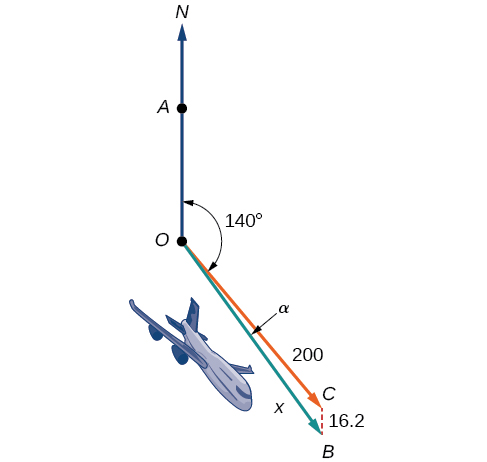
Ground speed refers to the speed of a plane relative to the ground. Airspeed refers to the speed a airplane can travel relative to its surrounding air mass. These two quantities are non the same considering of the effect of wind. In an earlier section, we used triangles to solve a similar trouble involving the motility of boats. Later in this section, nosotros will find the aeroplane's groundspeed and begetting, while investigating some other approach to problems of this type. Beginning, however, allow'southward examine the basics of vectors.
A Geometric View of Vectors
A vector is a specific quantity drawn as a line segment with an arrowhead at one end. It has an initial point, where it begins, and a terminal point, where it ends. A vector is divers past its magnitude, or the length of the line, and its direction, indicated by an arrowhead at the terminal point. Thus, a vector is a directed line segment. At that place are various symbols that distinguish vectors from other quantities:
- Lower case, boldfaced type, with or without an arrow on top such equally
5 , u , west , v → , u → , westward → . </math></strong>
- Given initial indicate
and terminal point
a vector can be represented as
The arrowhead on superlative is what indicates that it is not just a line, just a directed line segment.
- Given an initial indicate of
and terminal point
a vector may exist represented as
This last symbol
has special significance. It is called the standard position. The position vector has an initial signal
and a terminal point
To change any vector into the position vector, we remember almost the change in the x-coordinates and the modify in the y-coordinates. Thus, if the initial signal of a vector
is
and the terminal point is
and then the position vector is found by calculating
In [link], we see the original vector
and the position vector
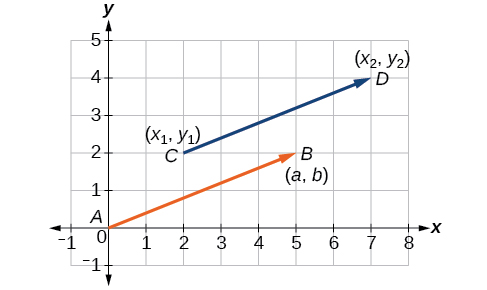
Backdrop of Vectors
A vector is a directed line segment with an initial signal and a concluding point. Vectors are identified by magnitude, or the length of the line, and direction, represented by the arrowhead pointing toward the concluding indicate. The position vector has an initial point at
and is identified by its terminal betoken
Find the Position Vector
Consider the vector whose initial bespeak is
and terminal bespeak is
Notice the position vector.
The position vector is found by subtracting one 10-coordinate from the other ten-coordinate, and ane y-coordinate from the other y-coordinate. Thus
The position vector begins at
and terminates at
The graphs of both vectors are shown in [link].
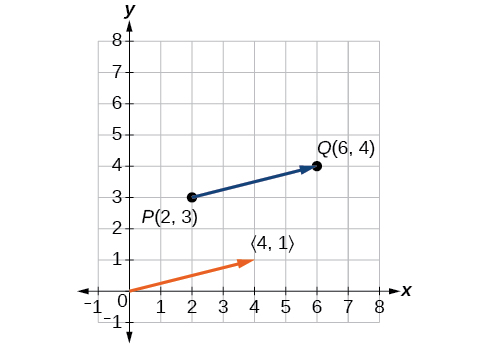
We run across that the position vector is
Drawing a Vector with the Given Criteria and Its Equivalent Position Vector
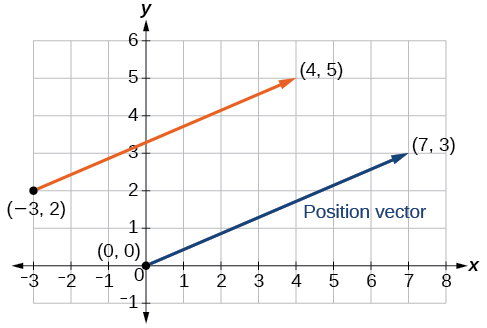
Notice the position vector given that vector
</math></strong>has an initial point at
and a last betoken at
so graph both vectors in the same aeroplane.
The position vector is establish using the following calculation:
Thus, the position vector begins at
and terminates at
Encounter [link].
Draw a vector
</math></potent>that connects from the origin to the point

Finding Magnitude and Management
To work with a vector, we demand to be able to find its magnitude and its management. We detect its magnitude using the Pythagorean Theorem or the altitude formula, and nosotros notice its management using the changed tangent role.
Magnitude and Management of a Vector
Given a position vector
</math></strong>
the magnitude is found past
The direction is equal to the angle formed with the ten-axis, or with the y-axis, depending on the application. For a position vector, the direction is found past
as illustrated in [link].
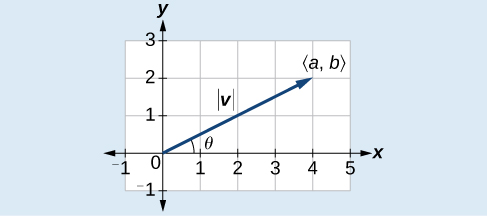
Two vectors v and u are considered equal if they have the same magnitude and the same direction. Additionally, if both vectors accept the aforementioned position vector, they are equal.
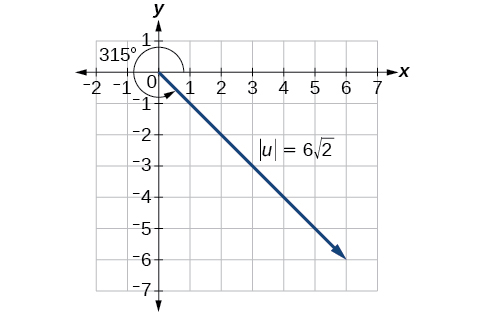
Finding the Magnitude and Management of a Vector
Detect the magnitude and management of the vector with initial signal
and terminal point
Draw the vector.
First, find the position vector.
We use the Pythagorean Theorem to discover the magnitude.
The management is given as
However, the bending terminates in the fourth quadrant, so we add 360° to obtain a positive angle. Thus,
Run across [link].
Showing That Ii Vectors Are Equal
Bear witness that vector 5 with initial point at
and terminal point at
is equal to vector u with initial indicate at
and concluding betoken at
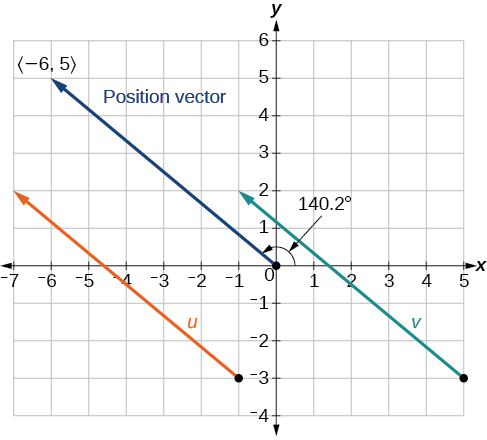
Draw the position vector on the aforementioned grid as v and u . Next, observe the magnitude and direction of each vector.
Every bit shown in [link], draw the vector
starting at initial
and terminal indicate
Draw the vector
with initial signal
and final point
Find the standard position for each.
Adjacent, notice and sketch the position vector for 5 and u . We take
Since the position vectors are the same, v and u are the aforementioned.
An alternative fashion to check for vector equality is to show that the magnitude and direction are the same for both vectors. To evidence that the magnitudes are equal, utilize the Pythagorean Theorem.
As the magnitudes are equal, we at present need to verify the direction. Using the tangent function with the position vector gives
All the same, we can see that the position vector terminates in the second quadrant, and then we add
Thus, the direction is
Performing Vector Improver and Scalar Multiplication
At present that we understand the properties of vectors, we tin can perform operations involving them. While it is convenient to think of the vector **
**
equally an pointer or directed line segment from the origin to the signal
vectors can exist situated anywhere in the plane. The sum of two vectors u and v , or vector addition, produces a tertiary vector u + v , the resultant vector.
To notice u + v , we start draw the vector u , and from the terminal cease of u , nosotros drawn the vector v . In other words, we have the initial betoken of v run into the final end of u . This position corresponds to the notion that we move along the offset vector and then, from its last signal, we move along the second vector. The sum u + 5 is the resultant vector because it results from addition or subtraction of two vectors. The resultant vector travels straight from the beginning of u to the end of 5 in a straight path, as shown in [link].
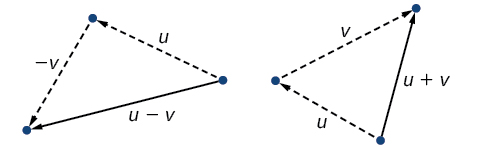
Vector subtraction is similar to vector addition. To discover u − v , view it as u + (− v ). Adding − v is reversing direction of five and adding it to the end of u . The new vector begins at the outset of u and stops at the end point of − v . See [link] for a visual that compares vector addition and vector subtraction using parallelograms.
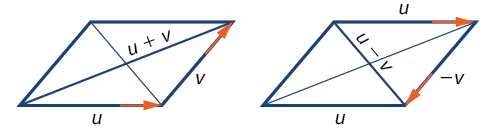
Adding and Subtracting Vectors
Given
</math></potent>
and
</math></strong>
find two new vectors u + 5 , and u − 5 .
To find the sum of two vectors, we add the components. Thus,
See [link](a).
To notice the difference of two vectors, add the negative components of
</math></strong>to
</math></stiff>Thus,
Run into [link](b).
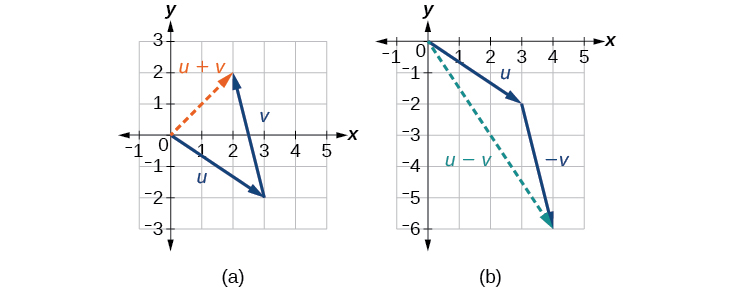
Multiplying Past a Scalar
While adding and subtracting vectors gives us a new vector with a different magnitude and direction, the process of multiplying a vector by a scalar, a constant, changes only the magnitude of the vector or the length of the line. Scalar multiplication has no effect on the management unless the scalar is negative, in which case the direction of the resulting vector is opposite the direction of the original vector.
Scalar Multiplication
Scalar multiplication involves the product of a vector and a scalar. Each component of the vector is multiplied by the scalar. Thus, to multiply
</math></potent>
by
, nosotros accept
Merely the magnitude changes, unless
is negative, and and so the vector reverses direction.
Performing Scalar Multiplication
Given vector
</math></stiff>
find three v ,
</math></strong>and − v .
See [link] for a geometric interpretation. If
</math></strong>
then
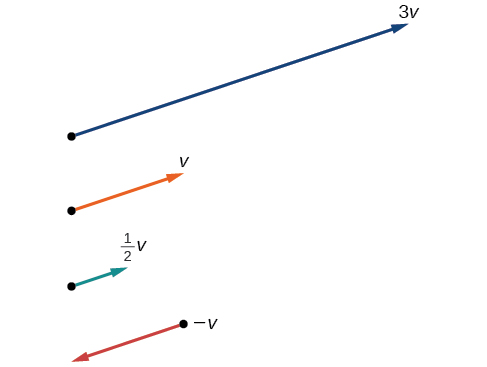
Analysis
Find that the vector iii five is three times the length of v ,
</math></strong>is half the length of 5 , and – five is the same length of v , but in the contrary direction.
Find the scalar multiple 3
</math></strong> given
</math></potent>
Using Vector Addition and Scalar Multiplication to Find a New Vector
Given
</math></potent>
and
</math></strong>
discover a new vector w = 3 u + 2 v .
Offset, we must multiply each vector past the scalar.
So, add the 2 together.
So,
</math></stiff>
Finding Component Form
In some applications involving vectors, it is helpful for us to be able to pause a vector down into its components. Vectors are comprised of 2 components: the horizontal component is the
direction, and the vertical component is the
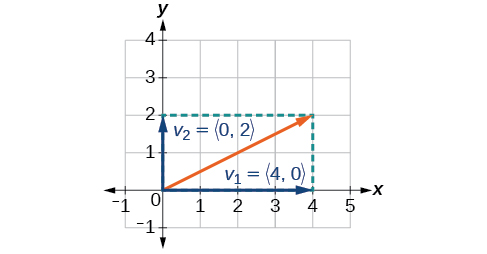
direction. For case, we tin can see in the graph in [link] that the position vector
comes from adding the vectors five one and five ii. We have v i with initial signal
and terminal point
We also have 5 ii with initial indicate
and terminal betoken
Therefore, the position vector is
Using the Pythagorean Theorem, the magnitude of v 1 is 2, and the magnitude of v 2 is 3. To find the magnitude of v , utilize the formula with the position vector.
The magnitude of v is
To observe the management, we use the tangent function
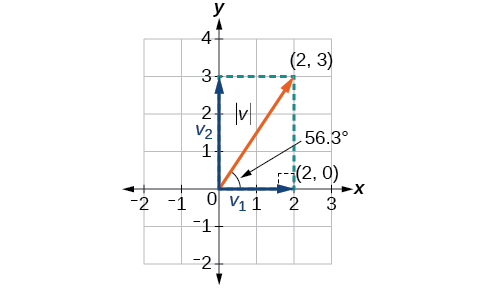
Thus, the magnitude of
</math></strong>is
and the direction is
off the horizontal.
Finding the Components of the Vector
Find the components of the vector
</math></strong>with initial betoken
and terminal point
Starting time find the standard position.
See the illustration in [link].
The horizontal component is
</math></stiff>
and the vertical component is
</math></strong>
Finding the Unit Vector in the Direction of v
In improver to finding a vector'south components, information technology is also useful in solving problems to find a vector in the same management as the given vector, just of magnitude ane. Nosotros phone call a vector with a magnitude of i a unit of measurement vector. We can then preserve the direction of the original vector while simplifying calculations.
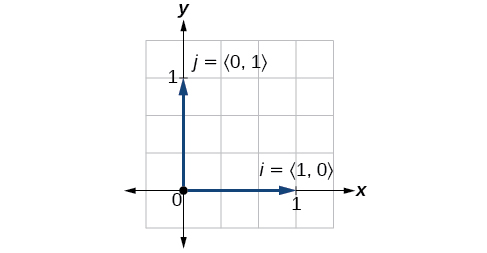
Unit vectors are defined in terms of components. The horizontal unit vector is written equally
</math></strong>
and is directed along the positive horizontal axis. The vertical unit vector is written as
</math></strong>
and is directed along the positive vertical axis. See [link].
The Unit Vectors
If
</math></potent>is a nonzero vector, then
</math></strong>is a unit vector in the direction of
</math></strong>Any vector divided by its magnitude is a unit vector. Find that magnitude is always a scalar, and dividing by a scalar is the same as multiplying by the reciprocal of the scalar.
Finding the Unit Vector in the Direction of *v*
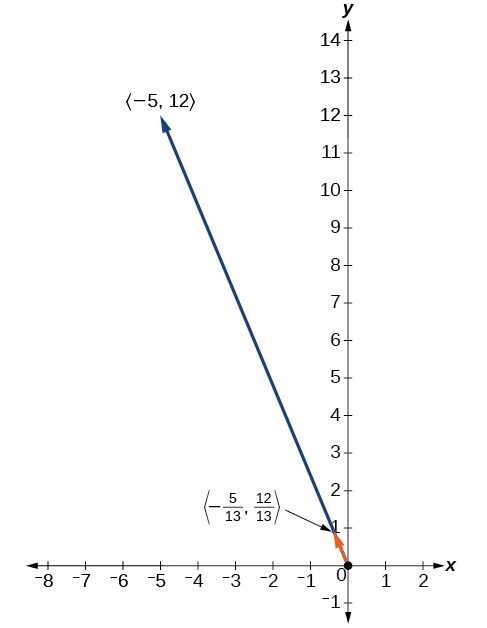
Notice a unit vector in the aforementioned direction as
</math></strong>
First, we will detect the magnitude.
Then nosotros divide each component by
which gives a unit vector in the same management as v :
or, in component form
See [link].
Verify that the magnitude of the unit vector equals ane. The magnitude of
is given as
The vector u
i
j is the unit vector in the aforementioned direction as v
Performing Operations with Vectors in Terms of i and j
So far, nosotros have investigated the basics of vectors: magnitude and management, vector addition and subtraction, scalar multiplication, the components of vectors, and the representation of vectors geometrically. Now that we are familiar with the general strategies used in working with vectors, we will represent vectors in rectangular coordinates in terms of i and j .
Vectors in the Rectangular Plane
Given a vector
</math></potent>with initial signal
and terminal point
v is written equally
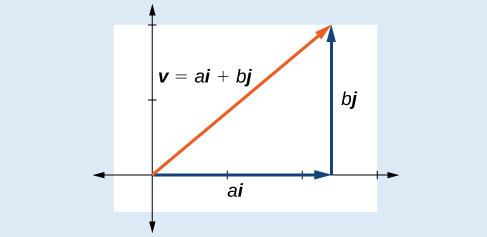
The position vector from
to
where
and
is written every bit v = ai + bj . This vector sum is called a linear combination of the vectors i and j .
The magnitude of five = ai + bj is given equally
See [link].
Writing a Vector in Terms of *i* and *j*
Given a vector
</math></strong>with initial point
and terminal point
write the vector in terms of
</math></potent>and
</math></potent>
Begin by writing the general form of the vector. Then supersede the coordinates with the given values.
Writing a Vector in Terms of *i* and *j* Using Initial and Concluding Points
Given initial point
and terminal point
write the vector
</math></stiff>in terms of
</math></stiff>and
</math></strong>
Begin by writing the general course of the vector. Then replace the coordinates with the given values.
Write the vector
</math></strong>with initial indicate
and last signal
in terms of
</math></strong>and
</math></strong>
Performing Operations on Vectors in Terms of i and j
When vectors are written in terms of
</math></strong>and
</math></strong>we can carry out addition, subtraction, and scalar multiplication by performing operations on corresponding components.
Adding and Subtracting Vectors in Rectangular Coordinates
Given v = ai + bj and u = ci + dj , and so
Finding the Sum of the Vectors
Notice the sum of
and
According to the formula, nosotros have
Calculating the Component Grade of a Vector: Direction
We take seen how to depict vectors co-ordinate to their initial and terminal points and how to observe the position vector. Nosotros have also examined notation for vectors drawn specifically in the Cartesian coordinate aeroplane using
For any of these vectors, nosotros can calculate the magnitude. Now, we want to combine the central points, and await further at the ideas of magnitude and direction.
Computing direction follows the same straightforward process we used for polar coordinates. We find the management of the vector by finding the angle to the horizontal. Nosotros practice this past using the basic trigonometric identities, merely with
</math></strong>replacing
</math></stiff>
Vector Components in Terms of Magnitude and Direction
Given a position vector
and a direction angle
Thus,
and magnitude is expressed as
Writing a Vector in Terms of Magnitude and Management
Write a vector with length seven at an bending of 135° to the positive 10-axis in terms of magnitude and management.
Using the conversion formulas
and
we find that
This vector can exist written as
or simplified as
A vector travels from the origin to the bespeak
Write the vector in terms of magnitude and direction.
Magnitude =
Finding the Dot Product of Two Vectors
Every bit nosotros discussed earlier in the department, scalar multiplication involves multiplying a vector by a scalar, and the effect is a vector. As we have seen, multiplying a vector by a number is called scalar multiplication. If we multiply a vector by a vector, at that place are two possibilities: the dot product and the cross product. Nosotros will merely examine the dot product hither; y'all may encounter the cantankerous product in more than avant-garde mathematics courses.
The dot product of two vectors involves multiplying two vectors together, and the result is a scalar.
Dot Product
The dot product of 2 vectors
and
is the sum of the product of the horizontal components and the product of the vertical components.
To find the angle between the ii vectors, use the formula below.
Finding the Dot Production of Two Vectors
Find the dot product of
</math></strong>and
</math></strong>
Using the formula, we take
Finding the Dot Product of Two Vectors and the Angle between Them
Find the dot production of v 1 = 5 i + ii j and v 2 = three i + 7 j . Then, find the angle between the ii vectors.
Finding the dot product, nosotros multiply respective components.
To discover the angle between them, we use the formula
See [link].

Finding the Angle between Two Vectors
Notice the angle betwixt
and
Using the formula, we accept
See [link].

Finding Footing Speed and Begetting Using Vectors
We now have the tools to solve the problem we introduced in the opening of the section.
An airplane is flying at an airspeed of 200 miles per hour headed on a SE bearing of 140°. A north air current (from north to due south) is bravado at sixteen.2 miles per 60 minutes. What are the basis speed and bodily bearing of the plane? Run into [link].
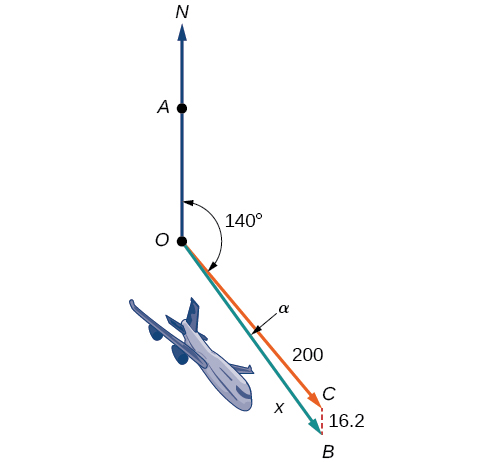
The footing speed is represented by
in the diagram, and we demand to find the angle
in club to calculate the adapted bearing, which will be
Notice in [link], that angle
must be equal to bending
past the rule of alternating interior angles, so bending
is 140°. Nosotros can find
by the Police of Cosines:
The basis speed is approximately 213 miles per hr. Now nosotros tin can summate the bearing using the Law of Sines.
Therefore, the plane has a SE bearing of 140°+2.eight°=142.8°. The ground speed is 212.7 miles per hour.
Key Concepts
- The position vector has its initial betoken at the origin. See [link].
- If the position vector is the same for two vectors, they are equal. Meet [link].
- Vectors are defined by their magnitude and direction. Encounter [link].
- If 2 vectors have the same magnitude and management, they are equal. See [link].
- Vector addition and subtraction result in a new vector found by adding or subtracting corresponding elements. Encounter [link].
- Scalar multiplication is multiplying a vector by a constant. Only the magnitude changes; the direction stays the same. See [link] and [link].
- Vectors are comprised of two components: the horizontal component along the positive ten-axis, and the vertical component along the positive y-axis. See [link].
- The unit vector in the aforementioned direction of whatsoever nonzero vector is found by dividing the vector by its magnitude.
- The magnitude of a vector in the rectangular coordinate system is
See [link].
- In the rectangular coordinate system, unit vectors may be represented in terms of
i </math></strong> and
j </math></stiff> where
i </math></potent>represents the horizontal component and
j </math></strong>represents the vertical component. Then, v = a i + b j is a scalar multiple of
v </math></potent>by existent numbers
See [link] and [link].
- Adding and subtracting vectors in terms of i and j consists of adding or subtracting corresponding coefficients of i and corresponding coefficients of j. Meet [link].
- A vector five = ai + bj is written in terms of magnitude and direction as
See [link].
- The dot product of two vectors is the production of the
i </math></stiff>terms plus the product of the
j </math></stiff>terms. Come across [link].
- Nosotros tin can employ the dot production to find the angle between two vectors. [link] and [link].
- Dot products are useful for many types of physics applications. Run into [link].
Section Exercises
Verbal
What are the characteristics of the letters that are commonly used to represent vectors?
lowercase, assuming letter, usually
How is a vector more specific than a line segment?
What are
</math></strong>and
</math></strong>and what practise they represent?
They are unit vectors. They are used to correspond the horizontal and vertical components of a vector. They each have a magnitude of 1.
When a unit vector is expressed as
which letter is the coefficient of the
</math></strong>and which the
</math></strong>
The first number always represents the coefficient of the
and the second represents the
Algebraic
Given a vector with initial point
and terminal point
find an equivalent vector whose initial bespeak is
Write the vector in component class
Given a vector with initial betoken
and terminal bespeak
find an equivalent vector whose initial bespeak is
Write the vector in component form
Given a vector with initial bespeak
and terminal point
find an equivalent vector whose initial point is
Write the vector in component form
For the following exercises, decide whether the two vectors
</math></strong>and
</math></strong>are equal, where
</math></strong>has an initial point
and a terminal point
and
</math></strong> has an initial point
and a terminal betoken
.
and
not equal
and
and
equal
and
and
equal
Given initial signal
and concluding point
write the vector
</math></strong>in terms of
</math></strong>and
</math></strong>
Given initial bespeak
and terminal betoken
write the vector
</math></strong>in terms of
</math></strong>and
</math></strong>
For the following exercises, use the vectors u = i + v j , v = −two i − 3 j , and due west = 4 i − j .
For the following exercises, use the given vectors to compute u + 5 , u − v , and two u − three 5 .
Let v = −4 i + three j . Find a vector that is one-half the length and points in the same direction every bit
</math></strong>
Let five = 5 i + 2 j . Find a vector that is twice the length and points in the opposite direction as
</math></stiff>
For the following exercises, find a unit of measurement vector in the same direction as the given vector.
b = −ii i + 5 j
u = −14 i + two j
For the following exercises, find the magnitude and management of the vector,
Given u = 3 i − 4 j and v = −2 i + 3 j , calculate
</math></strong>
Given u = − i − j and v = i + 5 j , calculate
</math></strong>
Given
and
calculate
</math></stiff>
Given u
and v
calculate
</math></strong>
Graphical
For the following exercises, given
</math></potent>draw
</math></potent>3 v and

For the following exercises, utilise the vectors shown to sketch u + 5 , u − v , and two u .


For the following exercises, use the vectors shown to sketch 2 u + v .


For the post-obit exercises, use the vectors shown to sketch u − 3 v .


For the post-obit exercises, write the vector shown in component form.


Given initial bespeak
and terminal point
write the vector
</math></potent>in terms of
</math></strong>and
</math></strong>then describe the vector on the graph.
Given initial point
and terminal point
write the vector
</math></strong>in terms of
</math></stiff>and
</math></strong>Draw the points and the vector on the graph.
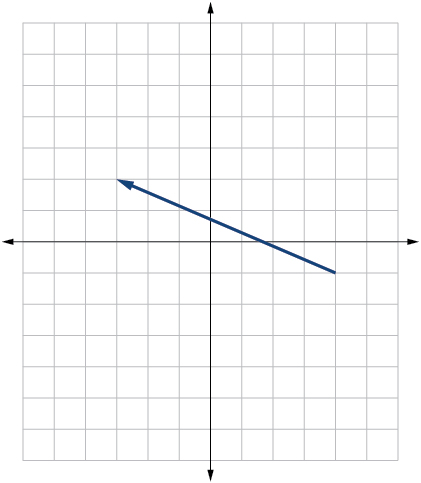
Given initial point
and concluding indicate
write the vector
</math></strong>in terms of
</math></strong>and
</math></stiff>Draw the points and the vector on the graph.
Extensions
For the post-obit exercises, use the given magnitude and management in standard position, write the vector in component form.
A 60-pound box is resting on a ramp that is inclined 12°. Rounding to the nearest tenth,
- Detect the magnitude of the normal (perpendicular) component of the strength.
- Find the magnitude of the component of the force that is parallel to the ramp.
a. 58.vii; b. 12.5
A 25-pound box is resting on a ramp that is inclined viii°. Rounding to the nearest tenth,
- Find the magnitude of the normal (perpendicular) component of the force.
- Find the magnitude of the component of the force that is parallel to the ramp.
Detect the magnitude of the horizontal and vertical components of a vector with magnitude 8 pounds pointed in a direction of 27° above the horizontal. Round to the nearest hundredth.
pounds,
pounds
Find the magnitude of the horizontal and vertical components of the vector with magnitude 4 pounds pointed in a direction of 127° above the horizontal. Round to the nearest hundredth.
Find the magnitude of the horizontal and vertical components of a vector with magnitude 5 pounds pointed in a direction of 55° above the horizontal. Round to the nearest hundredth.
pounds,
pounds
Find the magnitude of the horizontal and vertical components of the vector with magnitude i pound pointed in a direction of 8° above the horizontal. Round to the nearest hundredth.
Real-World Applications
A woman leaves dwelling and walks iii miles westward, and then 2 miles southwest. How far from home is she, and in what direction must she walk to head straight home?
4.635 miles, 17.764° Due north of E
A boat leaves the marina and sails 6 miles due north, then 2 miles northeast. How far from the marina is the boat, and in what direction must it sail to head directly back to the marina?
A human starts walking from habitation and walks 4 miles east, 2 miles southeast, 5 miles southward, 4 miles southwest, and 2 miles east. How far has he walked? If he walked direct abode, how far would he take to walk?
17 miles. 10.318 miles
A adult female starts walking from home and walks 4 miles east, 7 miles southeast, 6 miles south, 5 miles southwest, and 3 miles east. How far has she walked? If she walked straight dwelling, how far would she have to walk?
A man starts walking from home and walks iii miles at 20° due north of westward, so 5 miles at 10° west of southward, and then 4 miles at fifteen° northward of due east. If he walked straight home, how far would he have to the walk, and in what direction?
Distance: two.868. Direction: 86.474° North of West, or 3.526° West of North
A woman starts walking from dwelling house and walks 6 miles at 40° northward of east, then 2 miles at 15° east of southward, and then 5 miles at xxx° s of w. If she walked directly dwelling house, how far would she accept to walk, and in what management?
An plane is heading northward at an airspeed of 600 km/hr, but in that location is a wind blowing from the southwest at 80 km/hr. How many degrees off form will the plane end up flying, and what is the aeroplane's speed relative to the ground?
4.924°. 659 km/hr
An plane is heading north at an airspeed of 500 km/hour, simply there is a air current bravado from the northwest at fifty km/hr. How many degrees off course volition the aeroplane terminate upward flying, and what is the plane'south speed relative to the ground?
An aeroplane needs to head due n, just there is a wind blowing from the southwest at 60 km/hr. The plane flies with an airspeed of 550 km/hr. To stop up flying due north, how many degrees west of north will the pilot need to fly the plane?
4.424°
An airplane needs to head due north, only there is a wind blowing from the northwest at eighty km/hr. The plane flies with an airspeed of 500 km/60 minutes. To end up flying n, how many degrees west of north will the pilot need to fly the plane?
As office of a video game, the point
is rotated counterclockwise about the origin through an angle of 35°. Notice the new coordinates of this point.
Equally part of a video game, the point
is rotated counterclockwise about the origin through an angle of forty°. Find the new coordinates of this point.
Two children are throwing a ball back and forth directly across the dorsum seat of a machine. The brawl is being thrown x mph relative to the automobile, and the motorcar is traveling 25 mph down the route. If one child doesn't catch the brawl, and it flies out the window, in what direction does the ball fly (ignoring wind resistance)?
21.801°, relative to the car'southward forward direction
Two children are throwing a brawl dorsum and forth straight beyond the back seat of a car. The ball is being thrown 8 mph relative to the automobile, and the auto is traveling 45 mph down the road. If 1 child doesn't catch the ball, and it flies out the window, in what direction does the ball fly (ignoring air current resistance)?
A l-pound object rests on a ramp that is inclined xix°. Observe the magnitude of the components of the force parallel to and perpendicular to (normal) the ramp to the nearest 10th of a pound.
parallel: 16.28, perpendicular: 47.28 pounds
Suppose a body has a force of x pounds acting on information technology to the right, 25 pounds acting on it upward, and 5 pounds interim on it 45° from the horizontal. What unmarried force is the resultant force acting on the body?
Suppose a body has a strength of x pounds acting on it to the right, 25 pounds acting on it ─135° from the horizontal, and five pounds acting on it directed 150° from the horizontal. What single force is the resultant force acting on the torso?
19.35 pounds, 231.54° from the horizontal
The condition of equilibrium is when the sum of the forces acting on a torso is the nil vector. Suppose a body has a force of 2 pounds acting on it to the right, 5 pounds acting on it upward, and three pounds acting on it 45° from the horizontal. What single force is needed to produce a state of equilibrium on the body?
Suppose a body has a force of 3 pounds acting on it to the left, four pounds interim on it upward, and ii pounds acting on information technology thirty° from the horizontal. What single forcefulness is needed to produce a state of equilibrium on the body? Draw the vector.
5.1583 pounds, 75.8° from the horizontal
Chapter Review Exercises
Non-right Triangles: Law of Sines
For the following exercises, assume
is opposite side
is opposite side
and
is contrary side
Solve each triangle, if possible. Round each answer to the nearest tenth.
Not possible
Solve the triangle.
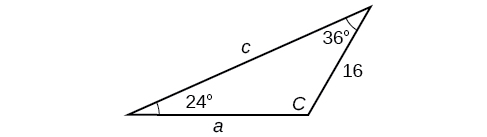
Observe the area of the triangle.
A pilot is flying over a straight highway. He determines the angles of depression to ii mileposts, 2.1 km apart, to exist 25° and 49°, every bit shown in [link]. Find the distance of the plane from betoken
and the acme of the plane.
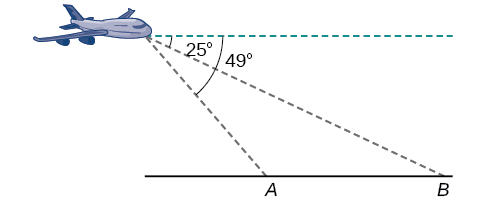
distance of the plane from betoken
ii.ii km, tiptop of the plane: 1.6 km
Non-right Triangles: Law of Cosines
Solve the triangle, rounding to the nearest tenth, assuming
is opposite side
is opposite side
and
s contrary side
Solve the triangle in [link], rounding to the nearest 10th.
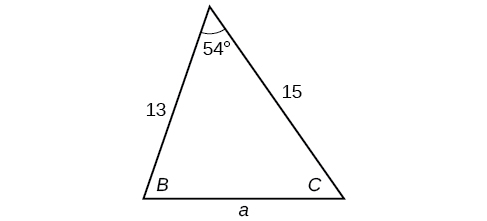
Notice the area of a triangle with sides of length 8.3, 6.6, and ix.1.
To find the distance between 2 cities, a satellite calculates the distances and angle shown in [link] (not to scale). Observe the altitude betwixt the cities. Round answers to the nearest tenth.
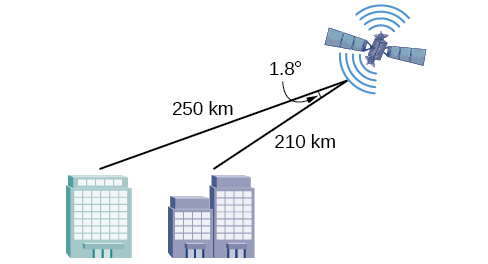
40.half-dozen km
Polar Coordinates
Plot the bespeak with polar coordinates
Plot the point with polar coordinates
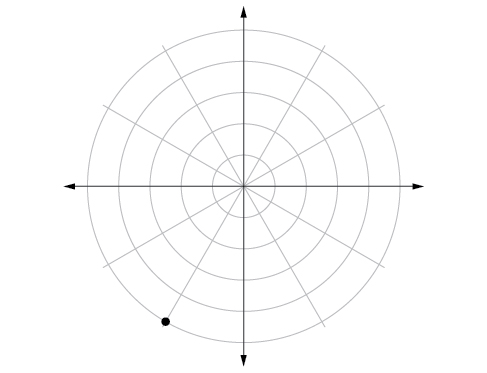
Convert
to rectangular coordinates.
Convert
to rectangular coordinates.
Convert
to polar coordinates.
Catechumen
to polar coordinates.
For the post-obit exercises, convert the given Cartesian equation to a polar equation.
For the post-obit exercises, convert the given polar equation to a Cartesian equation.
For the following exercises, convert to rectangular course and graph.
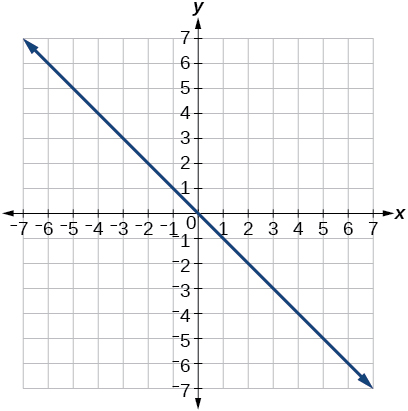
Polar Coordinates: Graphs
For the following exercises, test each equation for symmetry.
symmetric with respect to the line
Sketch a graph of the polar equation
Label the axis intercepts.
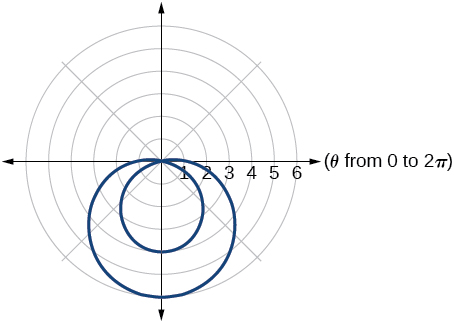
Sketch a graph of the polar equation
Sketch a graph of the polar equation
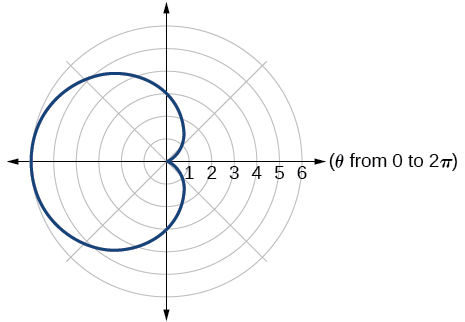
Polar Grade of Complex Numbers
For the following exercises, find the accented value of each complex number.
Write the complex number in polar form.
For the following exercises, convert the complex number from polar to rectangular grade.
For the following exercises, find the product
in polar form.
For the following exercises, notice the quotient
in polar form.
For the following exercises, find the powers of each complex number in polar grade.
Discover
when
Detect
when
For the post-obit exercises, evaluate each root.
Evaluate the cube root of
when
Evaluate the square root of
when
For the following exercises, plot the complex number in the circuitous plane.

Parametric Equations
For the following exercises, eliminate the parameter
to rewrite the parametric equation equally a Cartesian equation.
Parameterize (write a parametric equation for) each Cartesian equation by using
and
for
Parameterize the line from
to
so that the line is at
at
and
at
Parametric Equations: Graphs
For the following exercises, make a table of values for each set up of parametric equations, graph the equations, and include an orientation; then write the Cartesian equation.
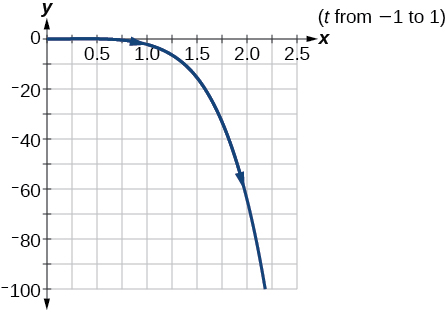
A ball is launched with an initial velocity of 80 feet per second at an angle of 40° to the horizontal. The ball is released at a tiptop of iv feet higher up the basis.
- Notice the parametric equations to model the path of the ball.
- Where is the ball afterwards 3 seconds?
- How long is the ball in the air?
- The ball is 14 feet loftier and 184 feet from where it was launched.
- 3.3 seconds
Vectors
For the following exercises, determine whether the 2 vectors,
</math></potent>and
</math></strong>are equal, where
</math></potent>has an initial point
and a last bespeak
and
</math></stiff>has an initial indicate
and a terminal bespeak
and
and
non equal
For the following exercises, use the vectors
</math></strong>and
</math></strong>to evaluate the expression.
For the following exercises, discover a unit vector in the aforementioned direction as the given vector.
For the following exercises, discover the magnitude and direction of the vector.
Magnitude:
Direction:
For the following exercises, summate
</math></strong>
u = −two i + j and v = 3 i + seven j
u = i + 4 j and v = 4 i + iii j
Given v
draw 5 , two v , and
v .
Given the vectors shown in [link], sketch u + five , u − 5 and three v .
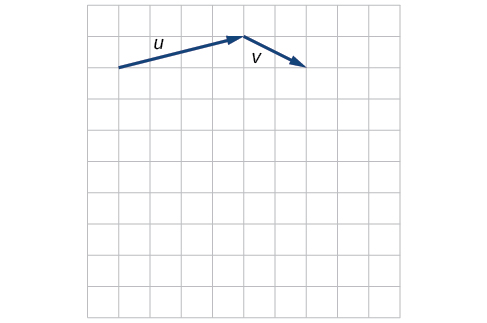
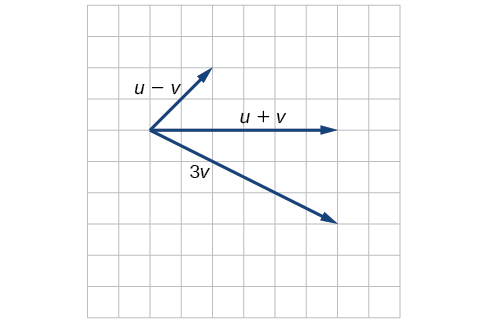
Given initial point
and terminal betoken
write the vector
</math></potent>in terms of
</math></strong>and
</math></potent>Draw the points and the vector on the graph.
Exercise Exam
Assume
is opposite side
is opposite side
and
is opposite side
Solve the triangle, if possible, and circular each answer to the nearest tenth, given
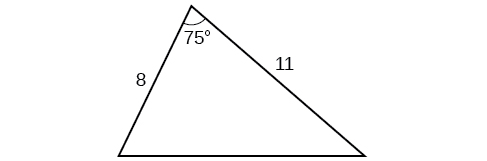
Find the surface area of the triangle in [link]. Round each reply to the nearest tenth.
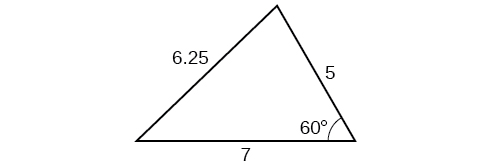
A pilot flies in a straight path for 2 hours. He and so makes a course correction, heading xv° to the correct of his original course, and flies 1 hour in the new direction. If he maintains a constant speed of 575 miles per hr, how far is he from his starting position?
Convert
to polar coordinates, and then plot the point.
Convert
to rectangular coordinates.
Convert the polar equation to a Cartesian equation:
Convert to rectangular class and graph:
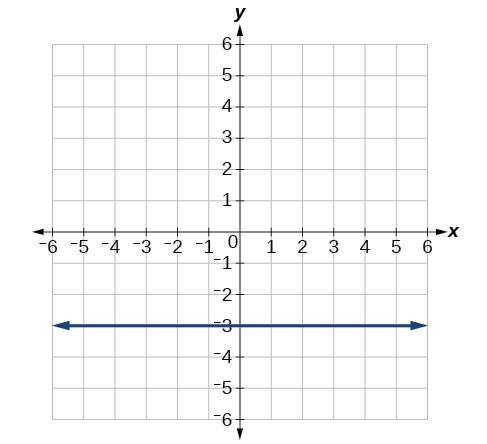
Examination the equation for symmetry:
Graph
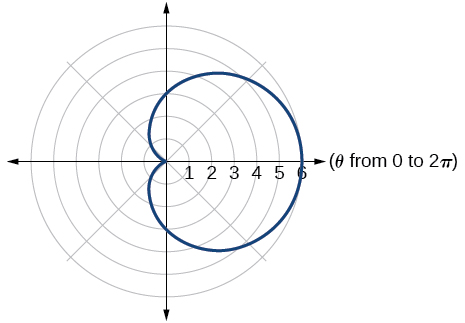
Observe the accented value of the complex number
Write the complex number in polar course:
Convert the complex number from polar to rectangular course:
Given
and
evaluate each expression.
Plot the complex number
in the complex aeroplane.
Eliminate the parameter
to rewrite the following parametric equations every bit a Cartesian equation:
Parameterize (write a parametric equation for) the following Cartesian equation by using
and
Graph the set of parametric equations and detect the Cartesian equation:
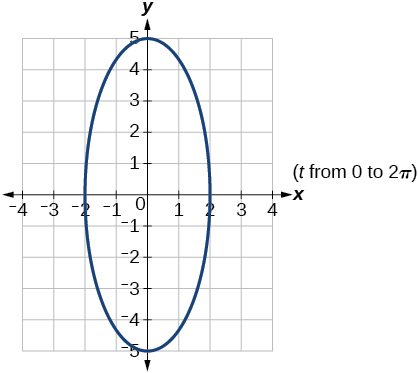
A ball is launched with an initial velocity of 95 feet per second at an bending of 52° to the horizontal. The ball is released at a height of 3.five anxiety to a higher place the ground.
- Observe the parametric equations to model the path of the brawl.
- Where is the brawl afterward 2 seconds?
- How long is the ball in the air?
For the post-obit exercises, use the vectors u = i − three j and five = 2 i + 3 j .
Calculate
</math></strong>
Discover a unit vector in the same direction equally
</math></potent>
Given vector
</math></strong>has an initial bespeak
and terminal indicate
write the vector
</math></stiff>in terms of
</math></strong>and
</math></strong>On the graph, draw
</math></strong>and
</math></stiff>
Glossary
- dot product
- given two vectors, the sum of the production of the horizontal components and the product of the vertical components
- initial point
- the origin of a vector
- magnitude
- the length of a vector; may represent a quantity such as speed, and is calculated using the Pythagorean Theorem
- resultant
- a vector that results from addition or subtraction of two vectors, or from scalar multiplication
- scalar
- a quantity associated with magnitude just not direction; a constant
- scalar multiplication
- the product of a constant and each component of a vector
- standard position
- the placement of a vector with the initial signal at
and the terminal point
represented by the alter in the ten-coordinates and the modify in the y-coordinates of the original vector
- terminal point
- the terminate bespeak of a vector, ordinarily represented by an arrow indicating its direction
- unit vector
- a vector that begins at the origin and has magnitude of 1; the horizontal unit vector runs along the ten-axis and is divers as
the vertical unit vector runs along the y-axis and is divers as
- vector
- a quantity associated with both magnitude and direction, represented as a directed line segment with a starting point (initial bespeak) and an end bespeak (terminal indicate)
- vector addition
- the sum of ii vectors, found by calculation corresponding components

This work is licensed under a Creative Eatables Attribution four.0 International License.
You can too download for complimentary at http://cnx.org/contents/fd53eae1-fa23-47c7-bb1b-972349835c3c@viii.1
Attribution:
- For questions regarding this license, please contact partners@openstaxcollege.org.
- If you lot use this textbook as a bibliographic reference, and so y'all should cite it as follows: OpenStax College, Precalculus. OpenStax CNX. http://cnx.org/contents/fd53eae1-fa23-47c7-bb1b-972349835c3c@8.one.
- If you redistribute this textbook in a print format, and then you must include on every physical folio the following attribution: "Download for free at http://cnx.org/contents/fd53eae1-fa23-47c7-bb1b-972349835c3c@8.ane."
- If y'all redistribute part of this textbook, then you must retain in every digital format page view (including but not express to EPUB, PDF, and HTML) and on every physical printed page the following attribution: "Download for costless at http://cnx.org/contents/fd53eae1-fa23-47c7-bb1b-972349835c3c@8.i."
Source: https://philschatz.com/precalculus-book/contents/m49412.html
0 Response to "in what direction must she walk to head directly home? (round your answer to three decimal places.)"
Post a Comment